

Wireless doorbells have become widely used in homes nowadays, as they are more popular among the public due to the elimination of cumbersome wiring. Breaking away from the wall-chiseling and wiring mode of traditional wired doorbells, wireless doorbells achieve signal transmission through wireless communication technology, Wireless Doorbell Kit requiring only a transmitter, a receiver, and wireless communication to function.
The transmitter is usually installed at the door, with a button on its surface and a built-in signal transmission module. When a visitor presses the doorbell button, the transmitter triggers a signal to generate a microcurrent, converting kinetic energy into an electrical signal. Some advanced models adopt self-generating technology, such as the Basic Kinetic Wireless Doorbell from Advent. These models require no batteries or plug-in power; pressing the button converts kinetic energy into electricity to power the signal transmission. Many wireless doorbell transmitters are powered by batteries like CR2032 to ensure stable signal emission. The core technology of the transmitter lies in encoding the button command and sending it as a wireless signal at a specific frequency, with 433.92MHz being common. This frequency is chosen for its strong anti-interference ability, making it suitable for short-distance transmission.
The receiver of the Compact Wireless Doorbell is typically placed indoors or plugged into a home socket. It contains a receiving module, a decoding circuit, a speaker, and control buttons. When the receiver captures the specific frequency signal from the transmitter, it first amplifies the signal, filters out interfering wireless waves, and then restores the wireless signal to the original command through the decoding circuit. Subsequently, the chip triggers the preset program, causing the doorbell to ring and the LED light to flash, achieving dual reminders (audio and visual).
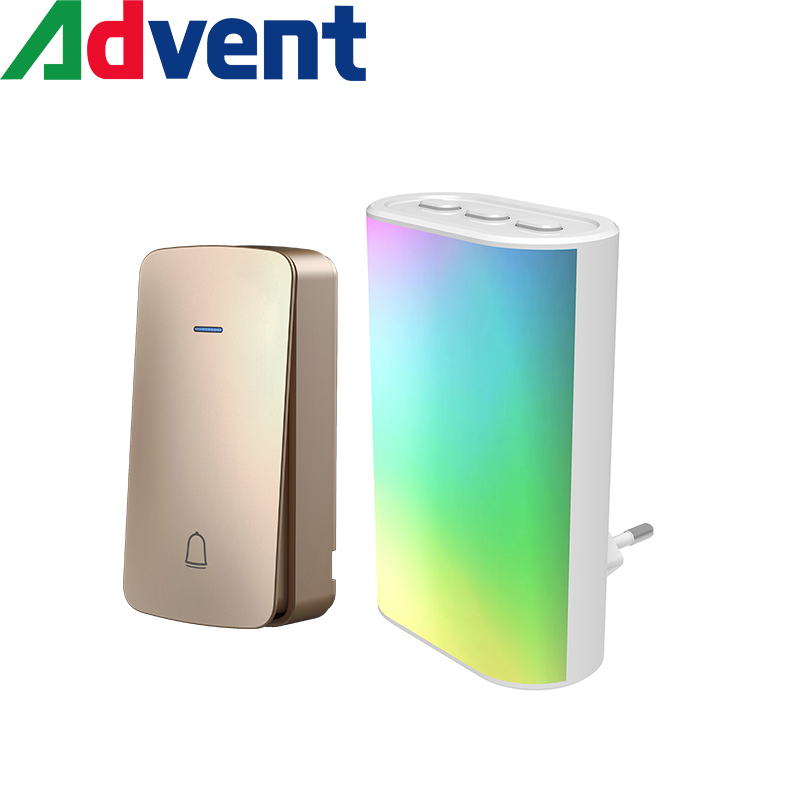
Wireless communication serves as the hidden bridge of wireless doorbells. To ensure stable signal transmission, the transmitter and receiver must first complete pairing. In open spaces, high-quality wireless doorbells can achieve a transmission distance of 100-150 meters.
From the signal sent by the transmitter to the command received by the receiver, wireless doorbells realize wireless visitor reminder functions through concise and efficient technology. They perfectly meet the needs of modern homes while ensuring signal stability and flexible usage.