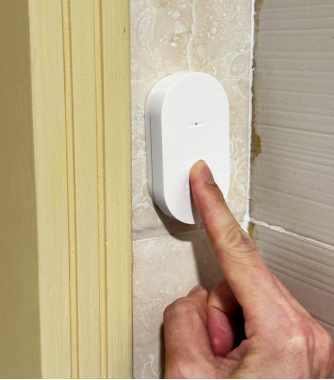
As global procurement buyers prioritize verifiable product performance over exaggerated marketing range data, our technical team completed standardized open air range testing for our kinetic self-powered wireless doorbell, with full on-site photos, instrument records and official factory test documents available for all overseas customers.
1.Open-Air Real Range Test with Professional Interference Detectors. Our first round of testing was conducted on an non-obstacle driveway, a standard open-space test location to eliminate signal deduction caused by walls, metal structures or other building materials. As shown in attached on-site photos, our engineers carried portable RF signal interference detectors to monitor ambient electromagnetic noise throughout the whole test, excluding signal fluctuation interference from power grid, factory equipment and parked vehicles. We fixed the indoor receiver at the starting point, then moved the self-powered transmitter outward in 10-meter increments, pressing the button repeatedly to record trigger stability, listen the sound playing from the receiver. After rounds of testing, the doorbell maintained 100% successful triggering at a maximum stable distance of 100M in open air areas. Many overseas purchasers raised two core concerns during sample evaluation: whether the open-air test result meets their need, and whether we can provide official factory testing records. We fully address both demands: we can issue formal factory standard test files, including test environment parameters, calibrated instrument serial numbers, repeated distance test average data and RF compliance statements. This document can be directly submitted to your local distributors, sales teams and QC departments to prove our range data is real measured value, not lab theoretical data.


2.Indoor Test for wireless doorbell. We set up indoor penetration test areas inside office buildings, simulating residential brick, concrete and drywall partition structures. Test results confirm the doorbell can work stably within 30 meters when separated by multiple solid walls between bell push button and receiver. Comparative testing with competing doorbell samples shows our optimized RF transmission module effectively avoids cross-frequency signal conflict, with zero missed triggers under dense multi-device interference. All test logs including wall material thickness, trigger success rate and timestamp data are sorted into supporting data packages. You can match these documents with our test shooting photos as persuasive supporting materials when communicating with overseas clients, greatly reducing after-sales complaints caused by short range RF products.