

Many customers may wonder about this question when purchasing a Wireless Digital Doorbells. Though it seems simple, it actually relates to the key factor behind the doorbell’s signal transmission. Today, let’s explore how wireless doorbells transmit signals.
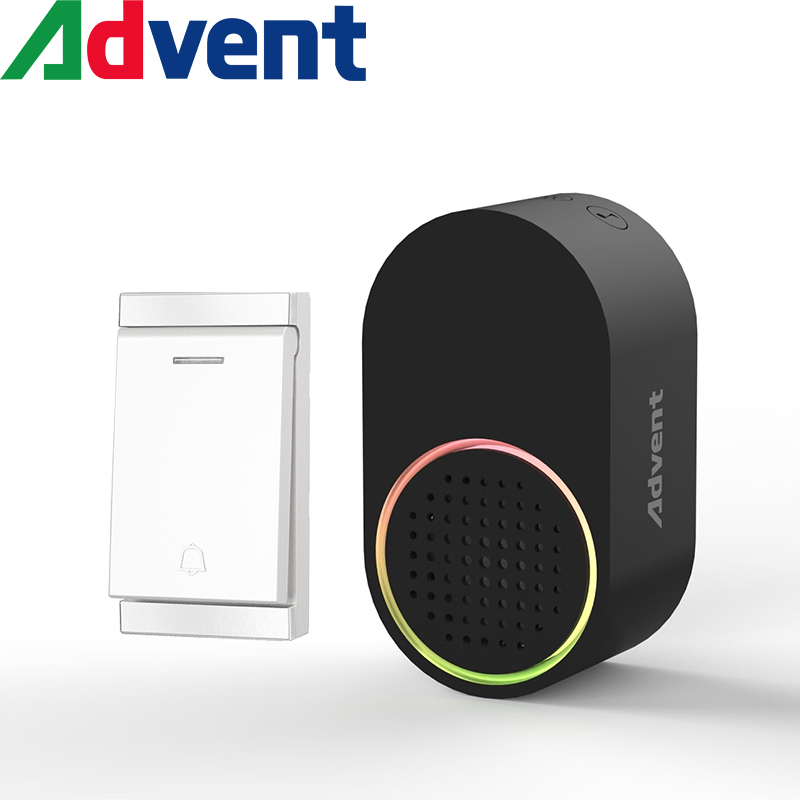
There are various types of wireless doorbells, including basic models, those with colored LED lights, and USB-powered ones. Naturally, Wi-Fi is not the only way for these doorbells to transmit signals.
The first type relies on radio frequency (RF) technology for signal transmission. The transmitter sends signals by converting mechanical energy into electrical energy. This kind of doorbell requires no Wi-Fi at all, as it communicates via an exclusive frequency band. Its signal can travel up to 150 meters, ensuring you can still receive signals even if there is no internet, a network outage, or a power failure at home.
The second type is the Wi-Fi-enabled wireless doorbell. This type needs to connect to Wi-Fi and link to a mobile app, allowing you to view the scene at your door remotely on your phone. It can also connect to smart door locks. However, its reliance on the network has drawbacks: remote functions fail when the network is down, and if the router malfunctions, even the local ringing function may be affected.
The third type is the smart Bluetooth-assisted doorbell, which combines Bluetooth and local ringing functions. When your phone is near the door, it pairs with the doorbell via Bluetooth, enabling temporary viewing and settings. When you are away from your phone, the doorbell only functions as a regular ringer. This type of doorbell does not fully depend on Wi-Fi, but remote functions (such as checking the door from another city) still require Wi-Fi or a mobile data network.
When choosing a doorbell, consumers can decide whether to opt for a Wi-Fi-enabled model based on their functional needs. Non-Wi-Fi models offer greater stability, lower usage costs, and easier maintenance, as they are not dependent on the network. Wi-Fi-enabled models, on the other hand, prioritize intelligence and allow remote control, but they come with the risks of network reliance and higher prices.
Returning to the original question—“Does a Wireless Remote Doorbells need Wi-Fi?”—the answer is no longer a simple “yes” or “no.” It reflects the development logic of smart homes: evolving from “single-function, dependent on exclusive connections” to “intelligent and diverse, embracing network collaboration,” and further to “integrated dual-mode, adapting to all scenarios.”
For users, Wi-Fi is not a necessity, but it is the key to unlocking smart security. Traditional radio frequency technology is not “outdated”; instead, it adheres to the demand for stability. In the future, with the popularization of 6G and Low-Power Wide-Area Network (LPWAN) technologies, the connection methods of wireless doorbells will become more flexible. What we need to do is understand the essence of our needs and choose the most suitable one for our homes—so that the doorbell is not just something that “rings,” but truly becomes an extension of home security and intelligent experience.